- All
- Product Name
- Product Keyword
- Product Model
- Product Summary
- Product Description
- Multi Field Search
 English
 Views: 0 Author: Site Editor Publish Time: 2026-08-14 Origin: Site
TL;DR:
LDPE laundry bags are durable and cost-effective for general use, while PVOH and PVA water soluble laundry bags are purpose-built for infection control. The right choice depends on your facility's hygiene standards, workflow, and environmental goals. Proudly offers certified, customizable solutions across all three types.
Hospitals, care homes, hotels, and industrial laundries handle thousands of soiled items every week. The wrong bag choice can mean staff exposure to pathogens, workflow disruptions, or unnecessary plastic waste. The right one keeps people safe and operations running smoothly.
For decades, facilities relied almost exclusively on LDPE laundry bags — low-density polyethylene bags prized for their toughness and low cost. But evolving infection control standards and sustainability pressures have shifted procurement conversations. Water soluble alternatives, particularly PVOH and PVA-based bags, are now earning serious attention from facility managers who need both safety and compliance.
This post breaks down how each bag type performs across the criteria that actually matter: durability, hygiene, dissolving behavior, environmental impact, and cost. It also explains where Proudly fits into this picture.
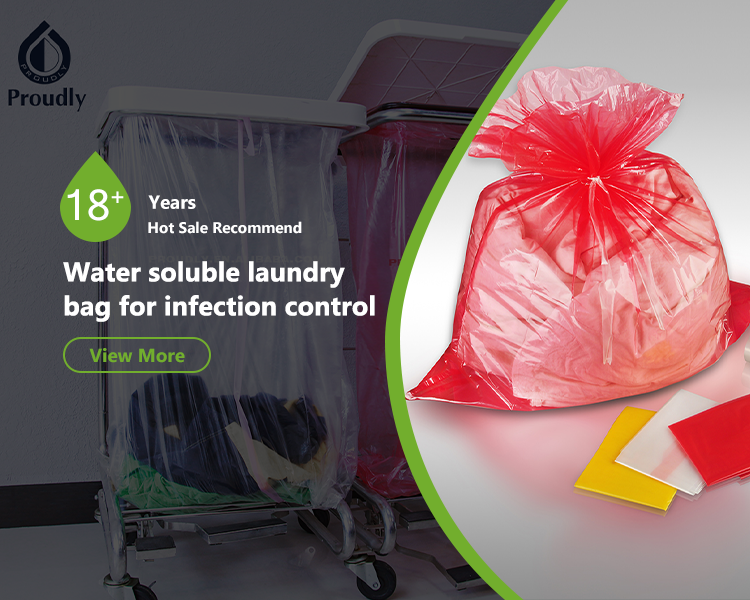
The three bag types share a common function — containing soiled laundry — but they're made from fundamentally different materials with different performance profiles.
LDPE (Low-Density Polyethylene) is a conventional plastic. It's flexible, moisture-resistant, and puncture-tough. These bags do not dissolve in water and must be removed before washing.
PVOH (Polyvinyl Alcohol) and PVA (Polyvinyl Alcohol) are terms often used interchangeably, though formulations can vary by manufacturer. Both refer to water soluble polymers that dissolve when exposed to water above a certain temperature. The key difference from LDPE is that these bags can go directly into the washing machine — contents, bag, and all — eliminating the need for staff to touch soiled items.
Feature | LDPE Laundry Bags | PVOH Water Soluble Bags | PVA Water Soluble Bags |
|---|---|---|---|
Material | Low-density polyethylene | Polyvinyl alcohol (cold/warm soluble) | Polyvinyl alcohol (warm/hot soluble) |
Dissolves in water | No | Yes (typically 40°C–60°C) | Yes (typically 60°C–90°C) |
Infection control suitability | Moderate | High | High |
Staff contact with soiled items | Required | Eliminated | Eliminated |
Biodegradability | Low | High (≥90% within 180 days under composting) | High |
Typical use case | General laundry, storage | Healthcare, hospitality, care homes | Healthcare, industrial, high-temp wash cycles |
Reusable | No | No | No |
Cost per unit | Low | Medium–High | Medium–High |
LDPE bags aren't going away. For facilities without strict infection control requirements — fitness centers, dry cleaners, student residences — they remain the most practical option. They're cheap to produce, easy to source globally, and compatible with virtually every storage and transport workflow.
Their resistance to moisture also makes them useful for containing wet items over extended periods without risk of the bag deteriorating prematurely. In supply chain and industrial contexts, LDPE laundry bags serve a straightforward containment role where the priority is strength and cost, not dissolution.
That said, their limitations are real. Every LDPE bag requires manual opening before washing, which means direct staff contact with soiled contents. In healthcare or any setting where contamination is a concern, this represents a workflow risk that water soluble alternatives are specifically designed to eliminate.
Healthcare laundry is regulated for good reason. Soiled linens from operating theaters, isolation wards, or infectious disease units can carry live pathogens. Any handling step between collection and washing is a potential exposure point.
PVOH water soluble laundry bags are engineered to close that gap. Once soiled items are loaded and the bag sealed, staff never need to open it again. The sealed bag goes directly into the washing machine drum. At the specified water temperature, the bag dissolves completely — releasing the contents and the detergent simultaneously — leaving no residue on the laundry or inside the machine.
This "never-open" workflow is now a recognized best practice in NHS-standard laundry protocols in the UK and is gaining regulatory traction in healthcare systems globally. The superior air barrier performance of these materials also inhibits the diffusion of harmful microorganisms during storage and transport — a critical feature in isolation and quarantine contexts.
Proudly's medical-grade water soluble laundry bags are manufactured with adjustable dissolving temperatures, meaning facilities with different wash cycle specifications can specify a bag that performs precisely at their target temperature. This flexibility is particularly valuable for facilities running mixed operations across standard and high-temperature wash programs.
Jiangmen Proudly Water-soluble Plastic Co., Ltd. has spent over 19 years developing functional, biodegradable packaging materials for medical, industrial, and consumer applications. With more than 300 employees and annual film sales exceeding 10,000 tons worldwide, Proudly operates at a scale that supports both custom development and large volume supply.
Proudly's water soluble laundry bag products carry ISO 9001 certification and have passed ecotoxicity and heavy metal tests. Their PVA film achieves a biodegradability rate of ≥90% within 180 days under composting conditions and ≥75% within 72 days under sewage water conditions — verified performance metrics that support environmental compliance reporting for facilities operating under sustainability mandates.
For procurement teams comparing suppliers, Proudly also offers PVA water soluble laundry bags in customizable sizes, thicknesses, and dissolving temperature ranges. OEM and ODM options are available for distributors and healthcare purchasing groups looking to private-label products for regional distribution.
There's no universally correct answer. The right laundry bag depends on your use case, infection control policy, wash cycle temperatures, and sustainability targets.
For general-purpose containment with minimal compliance requirements, LDPE bags remain the most economical option. For any setting where staff safety, hygiene assurance, or biodegradability is a priority — hospitals, aged care, premium hospitality, or industrial chemical handling — water soluble alternatives deliver measurable operational and risk management value.
Proudly's team supports procurement teams through product selection, technical specification, and compliance documentation. If your facility is evaluating a transition from conventional to water soluble bags, or scaling up an existing program, contact Proudly directly at proudly@proudly.com.cn or visit proudly.com.cn to request samples and pricing.
PVOH and PVA both refer to polyvinyl alcohol-based materials. The terms are often used interchangeably. In practice, formulation differences affect dissolving temperature, tensile strength, and biodegradability rate. Proudly offers multiple grades to match specific wash cycle and performance requirements.
Dissolving temperature varies by formulation. Most PVOH and PVA laundry bags dissolve between 40°C and 90°C. Proudly's bags are available in adjustable temperature specifications, allowing facilities to align bag performance with existing wash cycle standards.
Yes. Certified PVA and PVOH materials are designed to break down into non-toxic components. Proudly's products have passed ecotoxicity testing and are safe for marine life and standard wastewater treatment systems.
LDPE bags can be used for general linen containment in low-risk areas. However, for infectious or heavily contaminated laundry, most healthcare protocols recommend water soluble bags to eliminate staff exposure during handling.
Yes. Proudly provides OEM and ODM manufacturing for distributors and healthcare purchasing organizations. Custom sizes, thicknesses, print branding, and dissolving temperature specifications are all available on request.