- All
- Product Name
- Product Keyword
- Product Model
- Product Summary
- Product Description
- Multi Field Search
 English
Views: 0 Author: Site Editor Publish Time: 2026-11-19 Origin: Site
Hospitals, nursing homes, and care facilities handle thousands of pounds of soiled linen every day, and much of it carries a real risk of cross-contamination. Staff who sort, bag, and transport that laundry are exposed to bacteria, viruses, and bodily fluids with every touch. That exposure is exactly the problem dissolvable laundry bags were designed to solve.
Unlike standard cloth or polyethylene bags, these bags are made from polyvinyl alcohol (PVA) film, a material that dissolves completely in hot water. That means contaminated linen can be sealed at the point of collection and never opened again until it's already inside the washing machine. No untying knots, no shaking out sheets, no direct contact with whatever is inside. For infection prevention teams, this single change removes one of the most common points of exposure in the entire laundry handling chain.
Traditional laundry bags require manual handling at multiple stages: collection, transport, and loading into the washer. Each handoff is a chance for pathogens to spread, whether through torn bags, leaking fluids, or simple human error. Facilities that have switched to dissolvable alternatives report fewer handling steps and a measurable drop in staff exposure incidents, since the bag itself becomes part of the wash cycle rather than an obstacle to it.
There's also a practical cost argument. Reducing the number of manual touchpoints lowers the chance of workplace injury claims tied to needlestick incidents or fluid exposure, and it cuts the labor time spent sorting contaminated items. Facilities juggling tight staffing budgets often find that the upfront cost of specialized bags pays for itself through reduced liability and faster turnaround on linen processing.
The science behind these bags isn't complicated, but it is precise. PVA film is engineered to hold its shape and strength at room temperature, yet break down rapidly once it hits water above a certain threshold, typically around 60–70°C depending on the film grade. This gives facilities a dependable dissolve point: the bag survives transport and storage, then disappears during the hot wash cycle without leaving residue on the fabric.
Manufacturers can also adjust the dissolving temperature and speed depending on the application. A facility processing linens in a short, high-heat commercial wash needs a different film specification than one using a longer, lower-temperature cycle. This flexibility is part of why the technology has spread well beyond hospitals into hotels, cruise lines, and elder care facilities, anywhere that staff safety and hygiene compliance matter.
Feature | Dissolvable Laundry Bags | Traditional Plastic/Cloth Bags |
|---|---|---|
Direct contact with soiled linen | None after sealing | Required during unloading |
Environmental impact | Biodegradable, water-soluble | Often non-biodegradable |
Risk of cross-contamination | Significantly reduced | Higher due to manual handling |
Reusability | Single-use, dissolves in wash | Often reused or discarded as waste |
Staff training required | Minimal | Moderate (proper unbagging technique) |
The comparison makes the case fairly clearly. Choose dissolvable bags if infection control and staff safety are the priority, especially in high-turnover environments like hospitals or care homes. Facilities with lower contamination risk, such as general hotel laundry, may still find value in the convenience, but the safety argument is strongest in clinical settings.
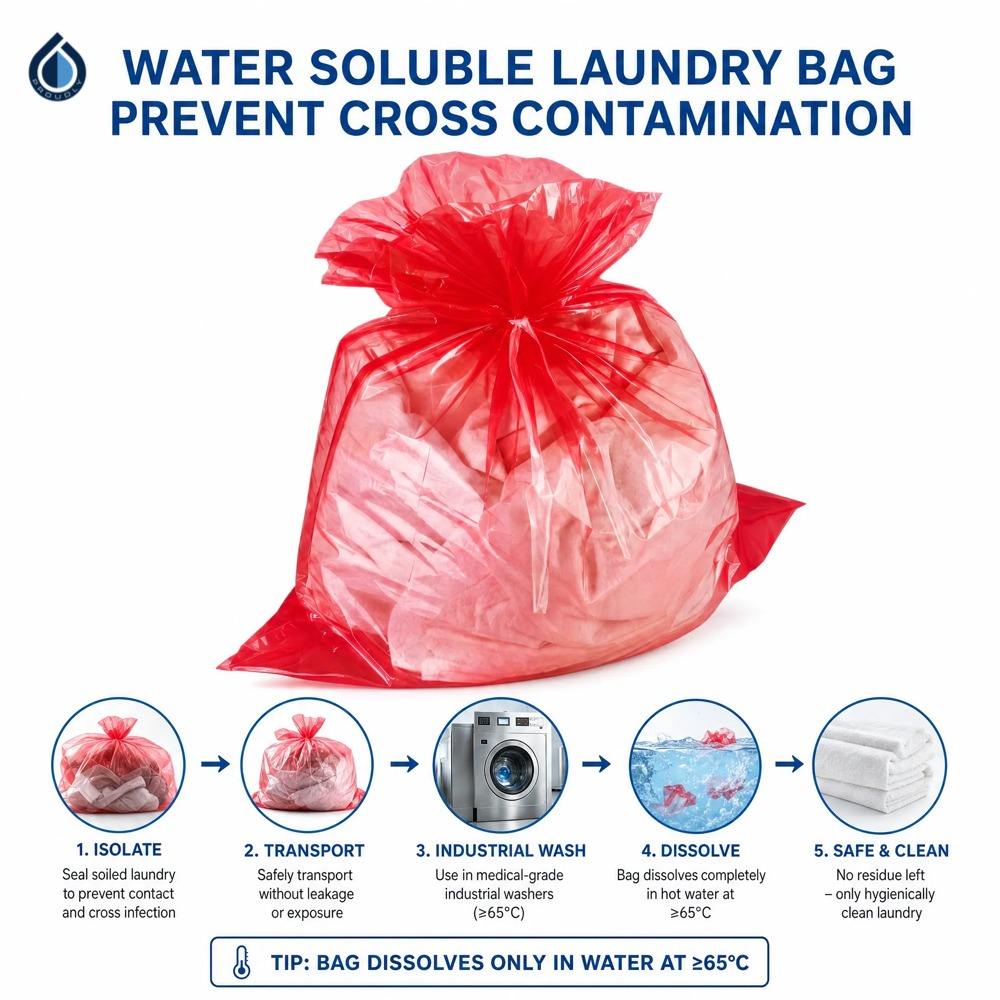
Not all water soluble laundry bags perform the same way, and the difference usually comes down to material formulation and manufacturing consistency. A well-made bag needs to hold up under normal handling, resist premature dissolving from ambient humidity, and break down completely without leaving film fragments that could clog washing equipment or stick to fabric.
Jiangmen Proudly Water-soluble Plastic Co., Ltd. has spent close to two decades refining this balance. The company's PVA film technology is built specifically for the demands of medical and healthcare laundry, with adjustable dissolving temperatures and a biodegradability rate of 90% or higher within 180 days under composting conditions. That combination of reliability and environmental performance is why Proudly has become a recognized name among facilities that can't afford to compromise on either hygiene or sustainability.
Safety testing matters just as much as dissolve performance. Proudly's materials have passed ecotoxicity and heavy metal testing, meaning the film poses no harm to people, animals, or the water systems the dissolved material eventually enters. For facilities that need to document compliance with infection control standards, that kind of verified safety profile isn't optional. It's the baseline requirement.
Laundry handling is just one piece of a hospital's infection prevention program, but it's a piece that's easy to overlook until something goes wrong. Hospital laundry bags built from dissolvable film integrate directly into existing protocols. Nursing staff bag soiled linen at the bedside, environmental services transports the sealed bag without opening it, and laundry staff load the entire bag into the machine. The chain of custody never breaks, and no one downstream needs to make contact with the contents.
This matters even more for facilities managing outbreaks or isolation patients, where every reduction in handling steps translates into a lower chance of transmission. Infection control committees increasingly list dissolvable bagging among their recommended practices precisely because it closes a gap that protocol alone can't fully address. You can write policies about proper glove use and bag-tying technique, but removing the need for that contact altogether is a more durable solution.
Facilities considering the transition don't need to overhaul their entire laundry workflow. Dissolvable bags typically slot into existing collection carts and transport systems, and most commercial washing machines handle the dissolve cycle without modification. The main adjustment is verifying that wash temperatures meet the film's dissolve threshold, which laundry managers can confirm with their film supplier before full rollout.
Staff training is also lighter than many facilities expect. Since the bags eliminate manual unbagging, there's less to teach rather than more. A short briefing on proper bag sealing at the point of collection usually covers what's needed.
The shift toward dissolvable laundry bags reflects a broader pattern in healthcare operations: solving contamination risk at the source rather than managing it after the fact. Facilities that have made the switch report smoother workflows, safer staff conditions, and a laundry process that finally matches the hygiene standards the rest of the hospital is already held to.