- All
- Product Name
- Product Keyword
- Product Model
- Product Summary
- Product Description
- Multi Field Search
 English
Views: 0 Author: Site Editor Publish Time: 2026-11-10 Origin: Site
Hospitals, nursing homes, and laundry service providers face a quiet but persistent risk every day: contaminated linens. Soiled bedsheets, gowns, and towels carry pathogens that can spread the moment a staff member touches them. That risk is exactly why facility managers across the healthcare sector have shifted toward water soluble laundry bags as their standard protocol for handling infectious or heavily soiled textiles.
These bags dissolve completely in hot water, which means staff never need to open or sort contaminated linens by hand. The bag goes straight into the washing machine, and the entire bundle — bag and linens together — comes out clean on the other side. It sounds simple, but the impact on worker safety and cross-contamination rates has been significant enough that this packaging category has grown steadily over the past two decades.
This post breaks down how these bags work, why facilities are adopting them, what to look for when sourcing them, and how the material compares to older alternatives.
The bags are made from polyvinyl alcohol, or PVA, a biodegradable polymer film engineered to break down when exposed to water at a specific temperature. Manufacturers can adjust the dissolving point depending on the intended use — some bags dissolve in cold water for delicate handling environments, while others are built to hold their shape until they hit the hot wash cycles typical of commercial laundry equipment.
This engineered dissolving speed is what separates a well-made bag from a cheap imitation. A bag that breaks apart too early during transport or storage defeats the entire purpose of containment. A bag that refuses to dissolve fully, on the other hand, leaves fragments that clog machinery or require manual removal, bringing staff back into contact with the very contamination the bag was meant to prevent.
Infection control teams care about one thing above all else: breaking the chain of transmission. Dissolvable laundry bags eliminate the step where a laundry worker has to untie, open, or shake out a bag full of soiled linens. That single change removes one of the most common points of exposure in hospital laundry operations.
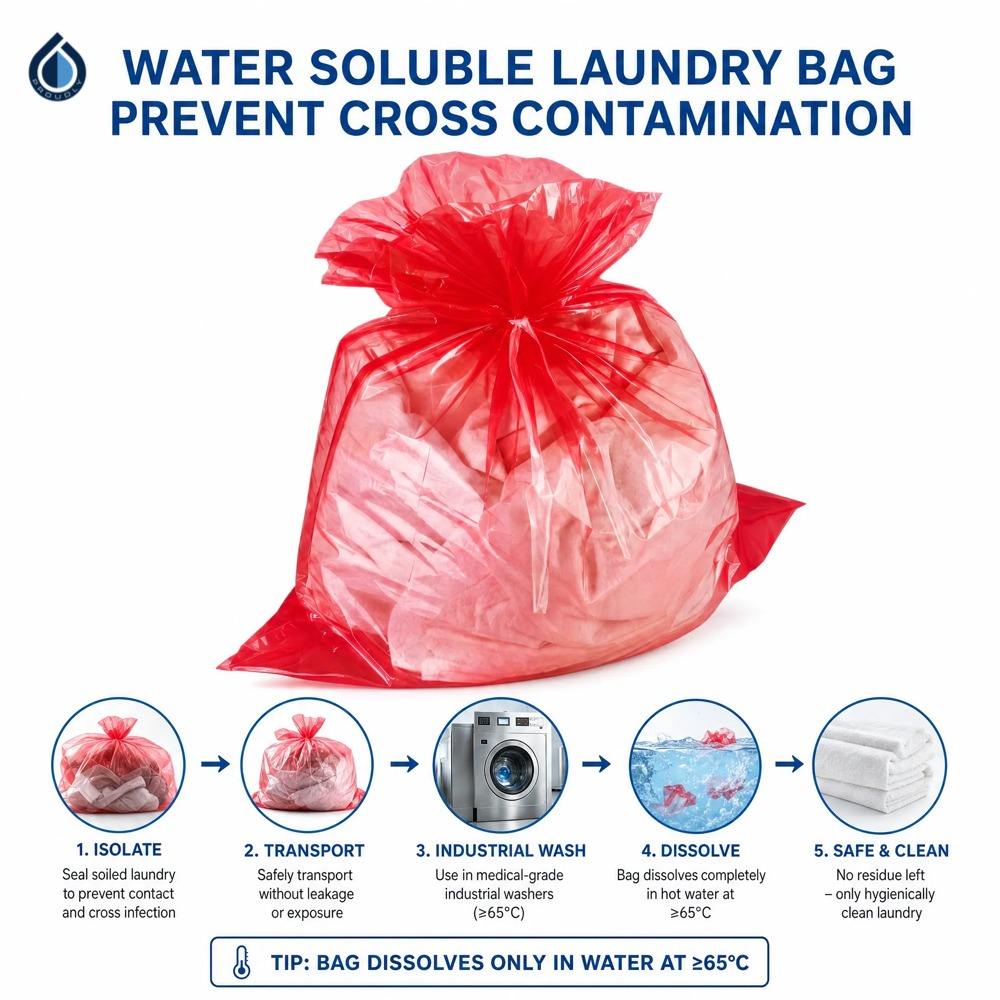
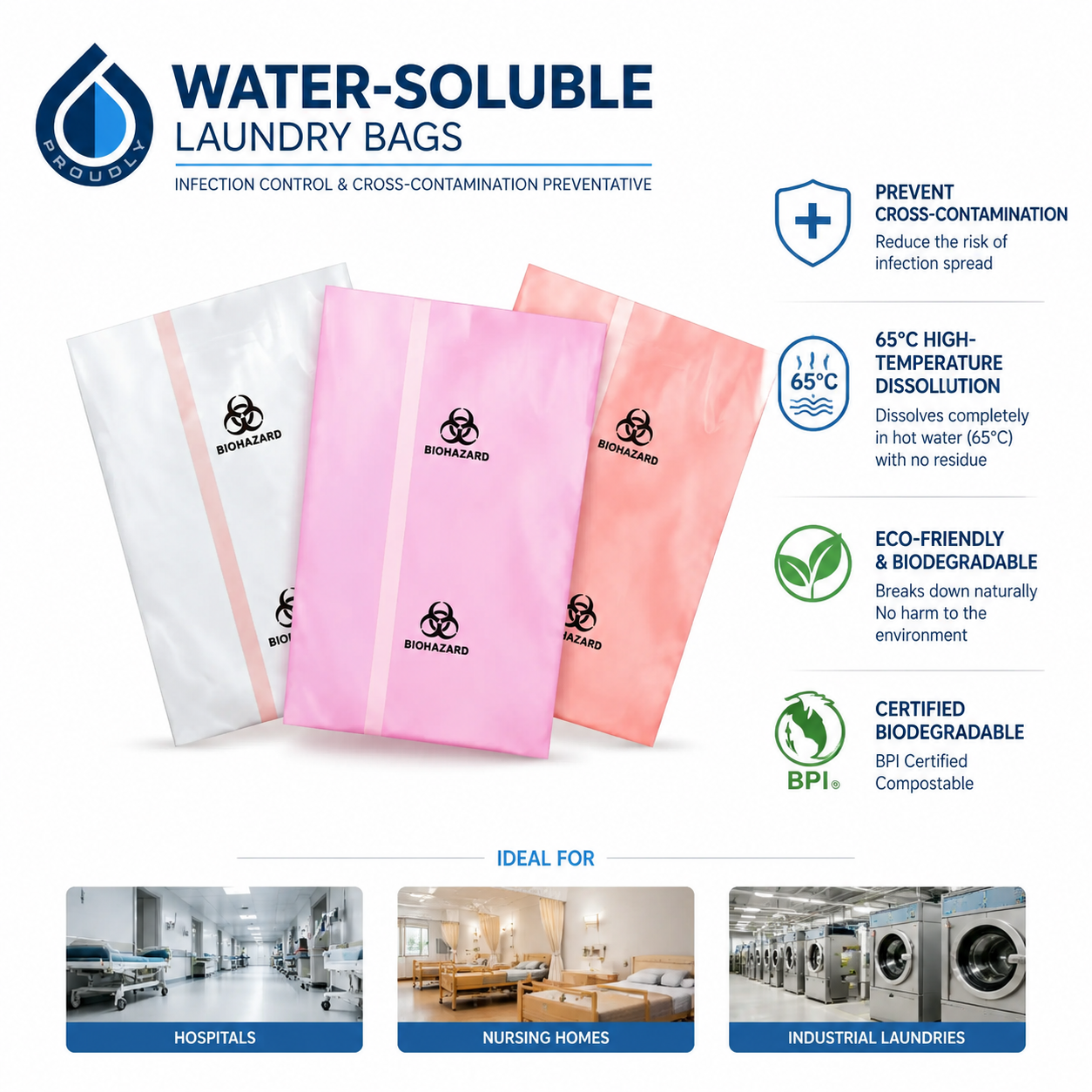
Beyond worker safety, there's an operational benefit too. Pre-sorted, bagged linens move faster through the laundry pipeline because staff aren't stopping to separate items by hand. Facilities that switched from standard plastic bags to dissolvable ones often report shorter processing times and fewer reported exposure incidents among laundry personnel.
Not every water-soluble film performs the same way, and the differences matter a great deal in a clinical setting. Buyers typically evaluate four factors: dissolve temperature, tensile strength, barrier performance against microorganisms, and biodegradability once the material enters wastewater systems.
The table below outlines how these factors generally compare across the three most common bag categories used in healthcare and institutional laundry.
Feature | Standard PVA Bags | Medical-Grade Soluble Bags | Cold-Water Soluble Bags |
|---|---|---|---|
Typical dissolve temperature | 60–70°C | 70–80°C | 20–30°C |
Air/microbial barrier | Moderate | High | Moderate |
Common use case | General laundry sorting | Infectious linen handling | Delicate or low-temp cycles |
Biodegradability (composting) | ≥75% in 72 days | ≥90% in 180 days | ≥75% in 72 days |
Typical setting | Hotels, laundromats | Hospitals, clinics, care homes | Specialty facilities |
Facilities handling infectious waste almost always default to medical-grade film because of its superior barrier performance. That barrier property, not just the dissolving function, is what actually stops airborne or surface transmission of harmful microorganisms during transport and storage.
Yes, and the difference is measurable. Traditional polyethylene laundry bags persist in landfills for decades. PVA-based film, by contrast, breaks down into water, carbon dioxide, and biomass under composting conditions, with biodegradability rates reaching 90% within 180 days for higher-grade formulations. For facilities trying to meet sustainability targets without compromising infection control standards, this is a meaningful trade-off in the right direction.
It's worth noting that dissolving in a washing machine is a different process from biodegrading in soil or compost. The bag disappears from sight the moment it hits hot water, but its full environmental breakdown happens afterward, in wastewater treatment or composting systems. Facilities that care about end-to-end sustainability should ask suppliers for biodegradability data specific to both stages.
Jiangmen Proudly Water-soluble Plastic Co., Ltd. has spent close to two decades developing functional, biodegradable packaging materials for healthcare, industrial, and consumer applications. The company's medical water-soluble laundry bags are engineered specifically for infection control, with an air barrier designed to limit the spread of harmful microorganisms during handling and transport.
What distinguishes a manufacturer in this space isn't just the ability to produce a bag that dissolves — it's consistency. A batch that dissolves reliably at the stated temperature, every time, is what keeps hospital laundry operations running without interruption. Proudly's background in functional film development, paired with ISO 9001 certification, reflects the kind of manufacturing discipline that institutional buyers tend to require before switching suppliers.
Dissolve temperature, film thickness, and bag size can all be adjusted depending on a facility's laundry equipment and workflow. A hospital running high-temperature commercial washers has different requirements than a care home with gentler cycle settings. Buyers evaluating Completely Soluble Laundry Bags should ask suppliers directly about dissolve-point customization rather than assuming a one-size-fits-all product will work across every laundry environment they operate.
Switching to water soluble laundry bags isn't just a packaging upgrade — it's a protocol change that touches worker safety, operational speed, and sustainability reporting all at once. Facilities still relying on manual sorting of contaminated linens are carrying a level of risk that this technology was specifically designed to eliminate.
Before making a switch, request dissolve-temperature data and biodegradability certifications from any supplier under consideration. A bag that performs well in a lab test but fails under real washing conditions creates more problems than it solves. Facilities that take the time to match film specifications to their actual laundry equipment tend to see the clearest results — fewer exposure incidents, faster processing, and a packaging material that actually breaks down the way it's supposed to.