- All
- Product Name
- Product Keyword
- Product Model
- Product Summary
- Product Description
- Multi Field Search
 English
Views: 0 Author: Site Editor Publish Time: 2026-10-07 Origin: Site
Sustainability targets are no longer a side project for hospitals, hotels, and care homes—they're a procurement requirement. Facilities managers now face pressure from regulators, corporate ESG mandates, and increasingly conscious guests and patients to show measurable progress on waste reduction. Laundry operations, often overlooked in sustainability audits, generate a surprising volume of single-use plastic waste every single day.
Water soluble laundry bags offer a straightforward way to close that gap. Instead of relying on conventional polyethylene bags that end up in landfill after a single use, facilities can switch to dissolvable laundry bags made from polyvinyl alcohol (PVA) film. These bags disappear completely during the wash cycle, leaving no plastic behind and no waste stream to manage.
This article looks at why commercial laundry operations are adopting Completely Soluble Laundry Bags as part of their sustainability strategy, what the environmental data actually shows, and how hygiene benefits reinforce the case for making the switch.
Every hospital ward, hotel housekeeping cart, and care home linen room relies on bags to transport soiled laundry safely. Multiply that by thousands of loads per week across a large facility, and the plastic waste adds up fast. Conventional laundry bags must be opened, discarded, and replaced with every single load—and since they're not designed to biodegrade, they sit in landfill indefinitely.
For organizations tracking Scope 3 emissions or reporting on waste diversion rates, this is a measurable and addressable line item. Unlike more complex sustainability initiatives that require capital investment or supply chain overhauls, switching laundry bag materials is a low-friction change with an immediate environmental payoff.
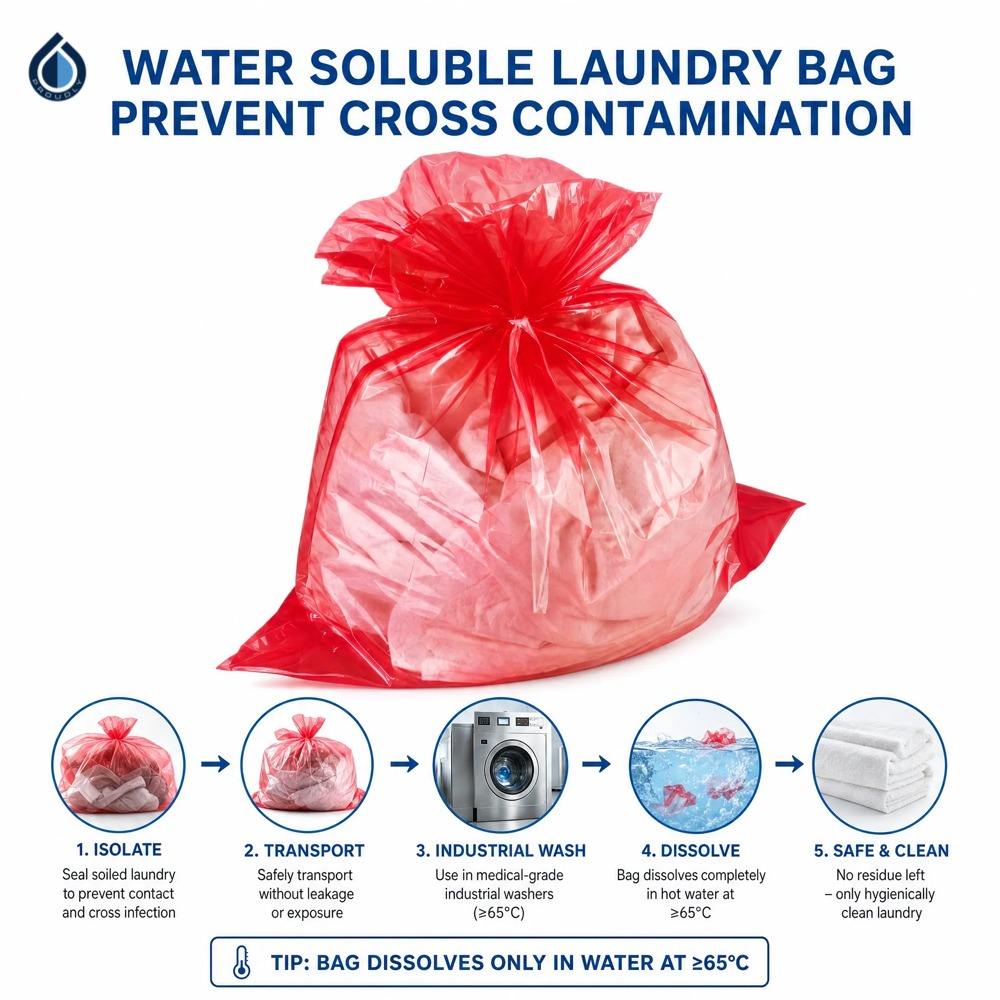
Dissolvable laundry bags are made from PVA film, a material engineered to stay stable during storage and transport but break down rapidly once exposed to water above a set temperature threshold. Soiled linens go directly into the bag at the point of collection. The sealed bag is loaded straight into the washing machine—no one has to open it, sort through it, or touch the contents. As the wash cycle runs, the film dissolves within minutes, and by the end of the cycle, there's no bag left at all.
That's the core sustainability advantage: there's no plastic waste to collect, no bag to send to landfill, and no packaging residue left behind. Compare that to a conventional plastic bag, which has to be physically removed from the laundry before washing and then disposed of separately.
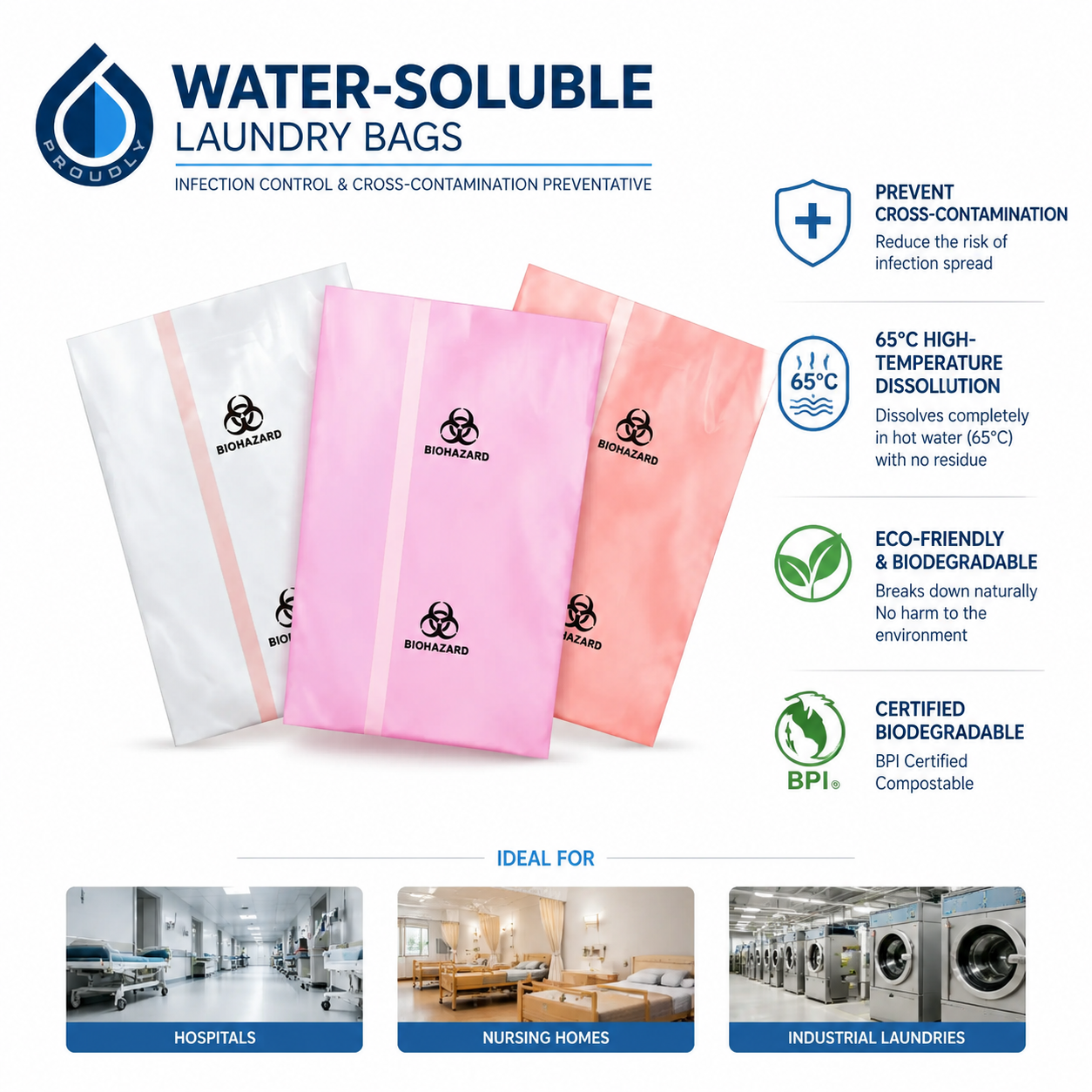
The environmental performance of PVA film is well documented. Under composting conditions, it achieves a biodegradability rate of 90% or more within 180 days. Under sewage water conditions, that rate reaches 75% within 72 days. For facilities trying to reduce their footprint without compromising on hygiene standards, these numbers matter when it comes time to report progress to stakeholders or regulators.
One underrated benefit of adopting water soluble laundry bags is how simple they are to incorporate into sustainability reporting. Facilities can calculate exactly how many conventional plastic bags they're eliminating per month, translate that into a waste-diversion figure, and show a direct, attributable reduction in single-use plastic consumption.
This kind of data is valuable for organizations pursuing ISO 14001 certification, responding to ESG questionnaires, or simply trying to demonstrate progress to leadership. Because dissolvable laundry bags replace a recurring, high-volume waste stream, the reduction is immediate and easy to track—unlike sustainability initiatives that take years to show measurable results.
Hospitals and clinics generate enormous volumes of laundry bag waste, particularly from isolation wards and operating theatres where infection control protocols require a bag per load. Replacing these with soluble alternatives cuts both plastic waste and the number of disposal steps staff need to follow.
Hotels and hospitality groups handle high-turnover linen volumes daily. Reducing single-use plastic across housekeeping operations supports broader sustainability commitments that guests increasingly expect from hospitality brands.
Care homes and assisted living facilities benefit from the dual advantage of reduced plastic consumption and simplified hygiene workflows, particularly when managing laundry from residents with infectious conditions.
Industrial and commercial laundries processing outsourced linen from multiple clients can use dissolvable laundry bags to cut plastic waste across their entire operation, not just a single site—multiplying the environmental impact across their full client base.
While the environmental case is the primary driver for many facilities now, the hygiene advantages of Completely Soluble Laundry Bags remain just as relevant. Because soiled linens never need to be removed from the bag before washing, staff avoid direct contact with contaminated items entirely. That eliminates a key point of cross-contamination risk in regulated environments like hospitals and care homes.
Switching to water soluble laundry bags for sustainability reasons doesn't require a trade-off on infection control. The two benefits reinforce each other: less plastic waste, and fewer opportunities for pathogens to spread during laundry handling.
Not every water soluble laundry bag performs the same way, so it's worth confirming a few specifications before committing to a supplier:
What is the dissolving temperature range, and can it be matched to your facility's wash cycle settings?
Has the film been tested for ecotoxicity and heavy metal content?
What biodegradability data can the manufacturer provide, and is it third-party verified?
What certifications does the manufacturing facility hold?
Can bag sizes and seal configurations be customized to your laundry volume?
Facilities operating under ISO or equivalent regulatory frameworks should ask for documentation confirming compliance before approving any new supplier.
Jiangmen Proudly Water-soluble Plastic Co., Ltd. has been developing and manufacturing functional water-soluble packaging materials since 2004—more than 19 years of focused expertise in this category. Based in Jiangmen, Guangdong, China, the company supplies over 10,000 tons of film annually to markets across Europe, North America, and Asia.
Proudly holds ISO 9001 certification and maintains a dedicated R&D team advancing the performance of PVA-based materials. Its water soluble laundry bags are engineered specifically for healthcare and infection control environments, with air barrier performance that prevents the diffusion of harmful microorganisms during storage and transit. Beyond laundry bags, Proudly manufactures a broad range of water-soluble and biodegradable solutions, including laundry detergent pods, industrial chemical packaging, and flushable packaging for personal care products—bringing genuine material science depth to every product line.
Transitioning to dissolvable laundry bags requires minimal operational change. Staff training typically takes less than an hour, the bags work with standard commercial washing machines without modification, and they store under normal warehouse conditions. The key step is matching the bag's dissolve temperature to your facility's wash cycle—cold-water dissolving bags suit low-temperature programs, while hot-water variants are built for high-temperature disinfection cycles common in medical laundry.
Reducing plastic waste in commercial laundry doesn't require a major capital project—it requires choosing the right bag. Water soluble laundry bags give hospitals, hotels, care homes, and industrial laundries a direct, measurable way to cut single-use plastic consumption while maintaining the hygiene standards their operations depend on.
For facilities managers evaluating this switch, working with an established manufacturer like Proudly—with 19+ years of experience and the certifications regulated industries require—offers a reliable path toward both sustainability goals and infection control standards.