- All
- Product Name
- Product Keyword
- Product Model
- Product Summary
- Product Description
- Multi Field Search
 English
 Views: 0 Author: Site Editor Publish Time: 2026-07-01 Origin: Site
TL;DR:
Modern packaging for sanitary napkins is shifting away from single-use plastic toward biodegradable and flushable alternatives. These innovations reduce environmental impact without compromising hygiene or product integrity. Proudly, a China-based manufacturer with over 19 years of experience, leads this shift with water-soluble and biodegradable packaging solutions.
Feminine hygiene is a daily necessity for hundreds of millions of people. Yet for decades, the packaging wrapped around each individual pad has barely changed—plastic pouches, foil laminates, and materials that can sit in a landfill for centuries. That's starting to change. Brands, retailers, and consumers alike are demanding more from the packaging they discard every day, and the industry is finally responding.
This post breaks down why sanitary napkin packaging matters, what the most promising eco-friendly formats look like, and how Proudly is helping manufacturers make the switch.
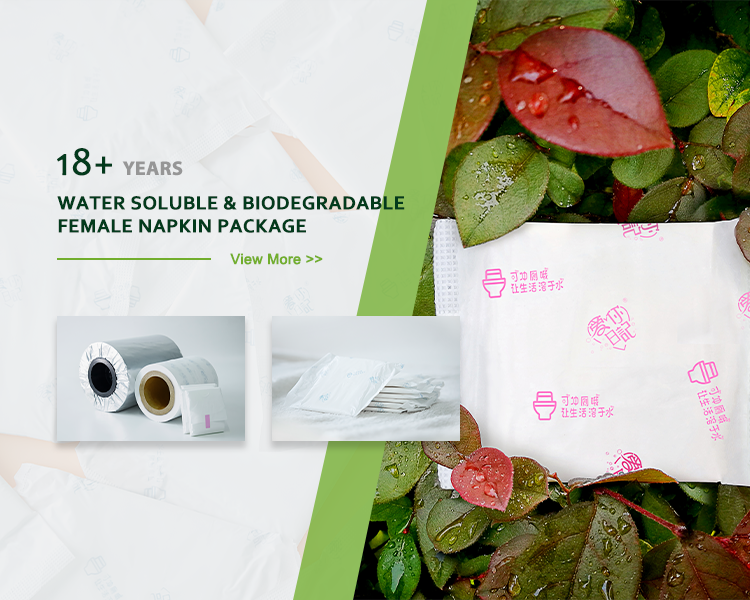

A single box of sanitary napkins typically contains 10 to 20 individually wrapped pads. Multiply that by the estimated 1.9 billion women of menstruating age worldwide, and the volume of packaging waste becomes staggering. Most of that packaging—thin plastic films, foil laminates, and composite materials—is not recyclable through standard municipal programs.
The problem isn't just volume. It's disposal. Traditional packaging ends up in general waste, incinerators, or worse, waterways and oceans. The materials resist breakdown for years, contributing to microplastic pollution and marine ecosystem damage.
Regulatory pressure is adding urgency. The European Union's Single-Use Plastics Directive and similar legislation in markets across Asia and North America are pushing brands to rethink not just the products themselves, but every layer of packaging around them. The good news is that the technology to make this shift already exists.
The market has converged around a few leading formats, each with distinct properties suited to different brand strategies and consumer behaviors. Here's a comparison of the most widely adopted options:
Packaging Type | Material Base | Compostable | Water-Soluble | Suitable for Individual Wrapping |
|---|---|---|---|---|
Traditional plastic pouch | Polyethylene | No | No | Yes |
Biodegradable film pouch | PLA / PBAT blend | Yes (industrial) | No | Yes |
Water-soluble PVOH pouch | Polyvinyl alcohol | Yes | Yes | Yes |
Flushable film wrap | Modified cellulose / PVOH | Yes | Yes | Yes |
Paper-based wrapper | Kraft / coated paper | Yes | No | Yes |
Each format involves trade-offs. Paper wrappers are widely accepted but can compromise moisture barrier performance. PLA-based films compost under industrial conditions, but home composting is unreliable. Water-soluble and flushable formats—built on PVOH (polyvinyl alcohol) technology—offer the most versatile end-of-life options, dissolving safely in water and breaking down biologically without leaving harmful residues.
For brands focused on the most eco-conscious positioning, the biodegradable individual pouch format has become the standout choice, particularly in markets where composting infrastructure is limited and consumers want packaging that disappears without a trace.


Proudly—formally known as Jiangmen Proudly Water-soluble Plastic Co., Ltd.—has spent over 19 years engineering PVOH-based packaging materials across medical, industrial, and consumer health categories. The company operates out of Jiangmen, Guangdong, China, and holds patents across biodegradable material development and water-soluble packaging design.
What sets Proudly apart technically is its dual manufacturing capability: both blow extrusion and solution cast processes for PVOH film production. This makes Proudly the only producer in China with both processes under one roof, which translates directly into greater material consistency, customizable film properties, and scalability for high-volume feminine hygiene clients.
Proudly's materials meet rigorous safety standards. The films are non-toxic, safe for incidental contact with skin and food-adjacent applications, and have passed both ecotoxicity and heavy metal tests. Biodegradability rates reach over 90% within 180 days under composting conditions, and over 75% within 72 days in sewage water conditions. These numbers are verifiable and certified under international standards.
For brands exploring the current landscape of packaging for sanitary napkins, Proudly's health care product line offers both standard and fully customized solutions designed to meet specific barrier, sealing, and dissolution temperature requirements.
The performance bar for sanitary napkin packaging is high. The wrapper must protect the product from moisture and contamination during storage and transport, open easily under use conditions, and—in the case of biodegradable or flushable alternatives—break down reliably after disposal.
A flushable individual pouch built on PVOH film dissolves rapidly when introduced to water, disintegrating in the drain without blocking pipes or releasing microplastics. This is a meaningful distinction from products marketed as "flushable" that merely fragment into smaller plastic pieces. True dissolution—not fragmentation—is what the PVOH-based approach delivers.
Brands choosing this format benefit from two angles. First, there's a genuine sustainability argument backed by material science. Second, there's a consumer communication advantage. Women are increasingly reading ingredient and material labels on hygiene products, and packaging that dissolves in water is a tangible, demonstrable benefit—not an abstract claim.
Of course, implementation requires more than just material selection. Film thickness, heat-seal strength, and dissolution temperature all need calibration for the specific product format. This is where Proudly's engineering support becomes relevant. The company works directly with manufacturers and brand teams to match material specifications to production equipment and end-use requirements.
Sustainable packaging in the feminine hygiene category is no longer an emerging trend—it's a market expectation that is moving into regulatory mandates. Brands that act now secure the lead time to test, validate, and scale these materials before compliance deadlines arrive.
The shift doesn't require a wholesale product redesign. In many cases, existing pad structures and production lines can accommodate biodegradable or water-soluble wrapper formats with targeted material substitutions. That's the opportunity Proudly positions itself to support: a technically grounded partner that understands the specific demands of feminine hygiene packaging and has the manufacturing scale to deliver at volume.
For any brand evaluating its packaging roadmap, the combination of material safety, biodegradability performance, and customization capability makes Proudly a partner worth exploring. Reach out to the Proudly team directly at proudly@proudly.com.cn or visit proudly.com.cn to review product specifications and request a quotation.
The most common materials are PVOH (polyvinyl alcohol), PLA (polylactic acid), PBAT, and kraft paper. PVOH-based films stand out because they are both water-soluble and biodegradable, making them suitable for flushable and compostable applications.
A genuine PVOH-based flushable pouch dissolves in water without fragmenting into microplastics or blocking pipes. It breaks down biologically in sewage water conditions. Products that only fragment rather than dissolve are not considered truly flushable.
This depends on the material. PLA-based films typically require industrial composting facilities at elevated temperatures. PVOH films dissolve in water and biodegrade in both composting and sewage conditions, making them more practical for everyday disposal.
Customization covers film thickness, dissolution temperature, sealing method, and print finish. Manufacturers like Proudly work with brand teams to align material specifications to production line equipment and product requirements before finalizing any format.
Regulatory frameworks in the EU, and increasingly in Asia-Pacific markets, are restricting single-use plastics. Early adoption allows brands to run material trials, adjust production processes, and build consumer communication around the switch—before compliance becomes mandatory.