
- All
- Product Name
- Product Keyword
- Product Model
- Product Summary
- Product Description
- Multi Field Search
 English
Views: 0 Author: Site Editor Publish Time: 2026-10-29 Origin: Site
Dishwasher pods look simple on the outside, but the single-dose convenience consumers love depends on a surprisingly sophisticated piece of packaging engineering. That thin, slightly glossy wrapper holding concentrated detergent together isn't just plastic — it's a specialized polymer designed to dissolve on contact with water, release its contents cleanly, and leave no residue behind. Understanding how this material works, and why manufacturers choose it, explains a lot about why single-dose cleaning products have taken over store shelves in the past decade.
This article breaks down what water soluble film actually is, how it's manufactured into finished pods, and what buyers should look for when sourcing it for their own production lines.
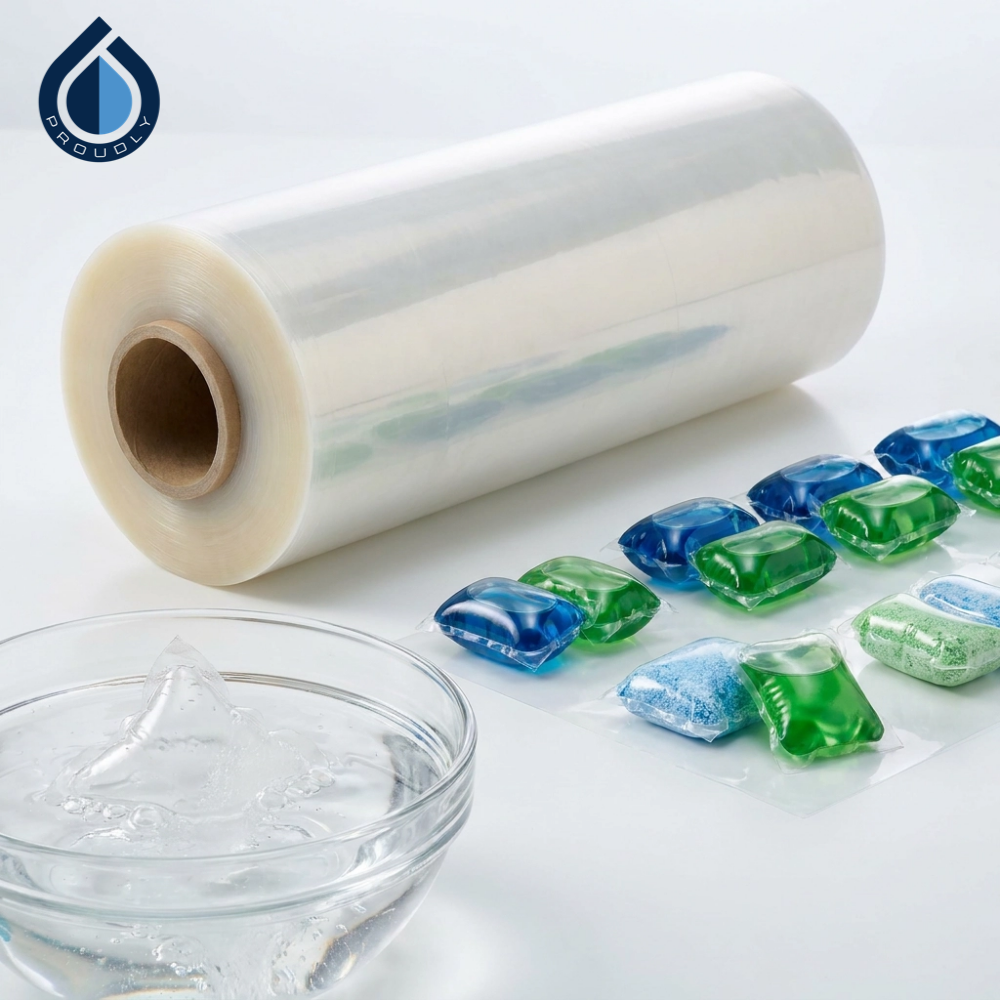
The film used in dishwasher and laundry pods is typically made from polyvinyl alcohol, or PVA — a synthetic polymer that's water-soluble but remains stable and strong under normal storage conditions. Manufacturers adjust the molecular weight and thickness of the film to control exactly how fast it dissolves, how much humidity it can tolerate before breaking down prematurely, and how well it seals around the detergent inside.
This tunability matters more than most consumers realize. A film that dissolves too slowly leaves a visible residue in the wash. One that dissolves too quickly risks breaking apart in storage or shipping, especially in humid climates. Manufacturers like Jiangmen Proudly Water-soluble Plastic Co., Ltd., which has focused on functional water-soluble materials since 2004, build their film formulations around adjustable dissolving temperature and speed, so brands can match the film to their specific detergent formula and climate conditions.
Traditional detergent packaging — bottles, boxes, scoops — creates waste, invites overdosing, and adds friction to the laundry or dishwashing routine. Pods wrapped in dissolvable film solve all three problems at once.
Here's a quick comparison of how film-wrapped pods stack up against traditional liquid and powder detergent packaging:
Factor | Film-Wrapped Pods | Liquid Bottles | Powder Boxes |
|---|---|---|---|
Dosing accuracy | Pre-measured, consistent | Relies on user judgment | Relies on user judgment |
Packaging waste | Minimal, dissolves fully | Plastic bottle disposal | Cardboard + plastic liner |
Storage convenience | Compact, stackable | Bulky, risk of spills | Bulky, risk of moisture damage |
User experience | Toss and go | Measure and pour | Measure and pour |
Biodegradability potential | High with proper film | Low (bottle) | Moderate (box only) |
This convenience factor is exactly why the capsule format has expanded well beyond laundry into dishwasher tabs, toilet cleaners, and even agricultural chemical packaging. Any product that benefits from pre-measured, mess-free dosing is a candidate for soluble film packaging.
Turning raw film and liquid detergent into a finished pod is a precise, high-speed process. A sheet of film is formed into a mold, filled with a measured dose of detergent, then sealed with a second layer of film on top — all without letting the liquid detergent touch and prematurely dissolve the wrapper. This is where equipment design becomes just as important as the film itself.

A well-engineered detergent pod machine needs to form, fill, and seal pods in rapid succession while keeping the film dry and intact until the exact moment of sealing. Cutting precision matters too — a poorly cut seam creates a weak point that can leak or tear during packaging and shipping. Manufacturers that produce both the film and the forming equipment have an advantage here, since they can fine-tune the two components to work together rather than troubleshooting compatibility issues after the fact.
Because this film touches concentrated detergent and, in some product lines, food-contact-adjacent applications, safety testing isn't optional. Quality PVA film should pass ecotoxicity testing and heavy metal testing, and it should be non-toxic to people, animals, and plants if accidentally ingested or released into the environment — an important consideration given how often pods are mistaken for candy by small children and pets.
Biodegradability is the other major selling point. Under composting conditions, high-quality water-soluble film can achieve a biodegradability rate of 90% or higher within 180 days, and under sewage water conditions, rates of 75% or higher within 72 days are achievable with the right formulation. For brands marketing sustainability alongside convenience, these numbers are worth verifying directly with suppliers rather than taking on faith, since film quality varies significantly between manufacturers.
Not all soluble film performs the same way, and the differences show up fast on a production line. A few questions worth asking any potential supplier:
Does the film's dissolve rate match your detergent's wash cycle? A mismatch leads to either residue or premature breakdown.
Can the supplier adjust thickness and formulation for different climates? Humidity tolerance varies by region, and a film that works in a dry warehouse may fail in a coastal one.
Is the film compatible with your existing forming and sealing equipment? Film thickness and elasticity affect how well it runs through automated machinery.
What biodegradability and safety certifications back up the product? ISO9001 certification and documented ecotoxicity testing are reasonable baseline expectations.
Suppliers with nearly two decades of experience in functional water-soluble materials, like Proudly, tend to have already solved many of these formulation challenges across medical, industrial, and consumer applications — which can shorten the trial-and-error period for brands entering the single-dose detergent category for the first time.
Beyond dishwasher pods, the same soluble film technology extends naturally into other single-dose formats. A laundry capsule works on the same core principle: concentrated detergent sealed in dissolvable film, released the moment it contacts water in the wash. Brands expanding from dishwasher tabs into laundry pods, or vice versa, can often use closely related film formulations and the same production infrastructure, which reduces both development time and tooling costs.
Single-dose detergent packaging isn't a passing trend — it's becoming the default format across laundry, dishwashing, and several industrial categories because it solves real problems around dosing accuracy, convenience, and waste. But the quality of the finished product depends entirely on getting two things right: a film formulated for your specific detergent and climate, and equipment calibrated to handle that film without compromising its integrity.
Brands evaluating suppliers for their next production run should request dissolve-rate testing, biodegradability documentation, and a trial run on their actual forming equipment before committing to a full-scale order. That upfront diligence is far cheaper than discovering a formulation mismatch after thousands of units have already shipped.