- All
- Product Name
- Product Keyword
- Product Model
- Product Summary
- Product Description
- Multi Field Search
 English
 Views: 0 Author: Site Editor Publish Time: 2026-09-04 Origin: Site
The humble laundry pod has come a long way from its novelty-product origins. What started as a convenient alternative to bulky detergent bottles has quietly become one of the fastest-growing segments in household cleaning—and much of that growth comes down to one underappreciated component: the film that wraps it all together.
That film does more than hold detergent in place. It dissolves cleanly in water, leaves no residue, and carries the entire wash cycle on its shoulders. For brands manufacturing pods at scale, and for consumers choosing between products, understanding the science and sourcing behind laundry pod film is increasingly relevant—especially as demand rises across global markets, including South Korea, Europe, and North America.
This post breaks down how laundry pod film works, what separates quality film from the rest, and why sourcing decisions made at the manufacturing level have a direct impact on performance, sustainability, and consumer trust.
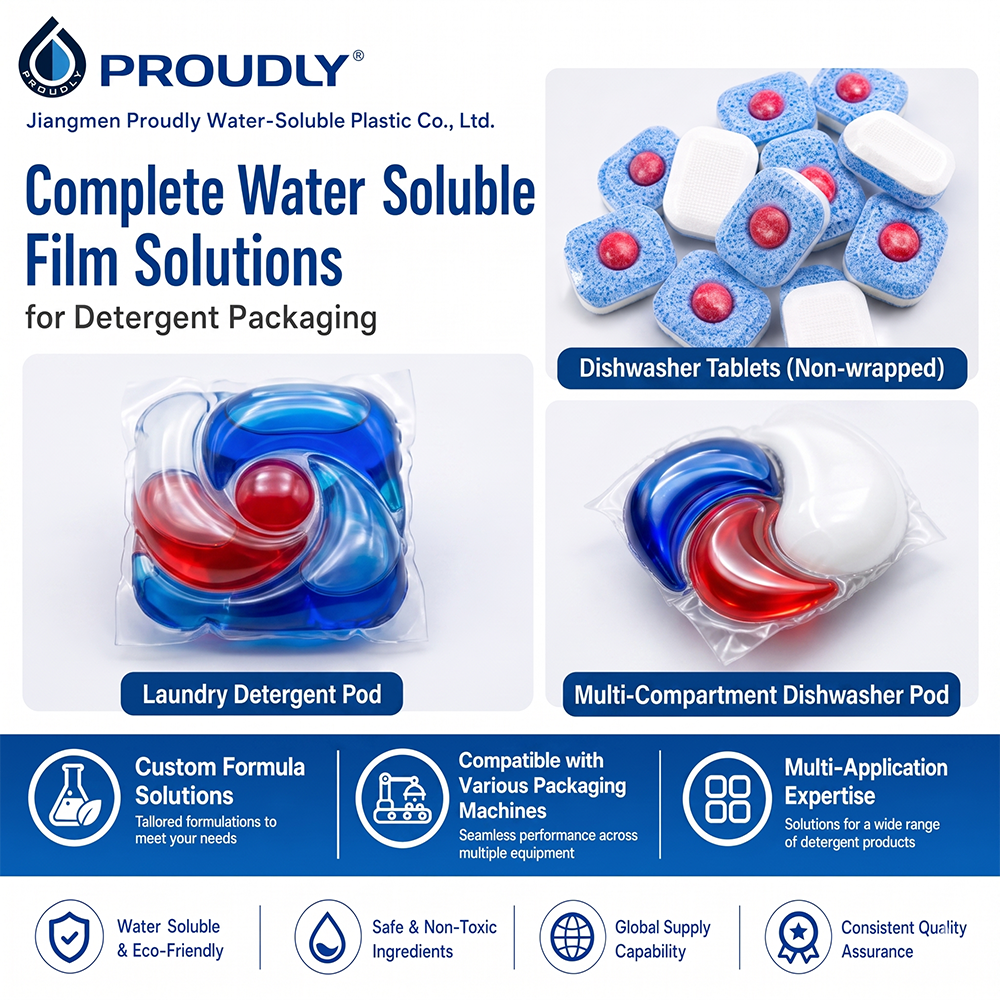

Most laundry pod films are made from polyvinyl alcohol (PVA), a water-soluble polymer that dissolves when it contacts moisture. The film acts as a sealed pouch, keeping concentrated detergent—liquid, powder, or gel—contained until the moment it hits the wash water.
The dissolving speed matters. Too fast, and the pod breaks down before it reaches the drum. Too slow, and detergent residue ends up on clothes or in the machine. High-quality PVA film is engineered with adjustable dissolving temperatures, meaning manufacturers can calibrate performance for cold-water washes, high-efficiency machines, or specific regional water conditions.
Beyond dissolving speed, the film must be strong enough to survive handling, packaging, and shipping—then disappear completely once its job is done. That balance between durability and biodegradability is what makes film formulation a genuinely technical challenge.
Not all PVA film performs equally. The differences show up in ways consumers notice directly: pods that leak in humid storage, detergent that doesn't fully release, or a greasy film left on fabrics after washing.
Here's a quick comparison of what separates standard film from premium-grade options:
Feature | Standard PVA Film | Premium PVA Film |
|---|---|---|
Dissolving consistency | Variable by water temp | Calibrated for cold & warm water |
Tensile strength | Moderate | High — handles filling & packaging stress |
Biodegradability rate | Varies | ≥90% within 180 days (composting) |
Transparency | Often cloudy | Clear or near-clear |
Formaldehyde absorption | Untested | Tested and certified safe |
Market certifications | Basic | ISO9001, ecotoxicity, heavy metals tested |
Proudly, a manufacturer based in Jiangmen, China with over 19 years of experience in water-soluble film production, developed its GX model film specifically for powder and liquid laundry capsules. The GX film is widely used across European, North American, and Chinese mainland markets, and has been tested for safety across ecotoxicity and heavy metal standards—two benchmarks that matter when a product contacts skin and enters wastewater systems.
South Korea has become one of the more demanding markets for laundry pod quality. Korean consumers are highly attentive to ingredient transparency, environmental claims, and packaging performance—and that scrutiny extends to the film itself.
Korea laundry detergent pods tend to compete on three factors: scent profile, cleaning strength, and visible pod quality. A cloudy or poorly sealed film signals low quality before the consumer even reads the label. Brands entering the Korean market often require film that is optically clear, dissolves reliably in cooler water temperatures common in Korean washing machine settings, and carries documentation to support eco-friendly claims.
Proudly supplies to markets with exactly these requirements. The company's water-soluble films are biodegradable at a rate of ≥75% within 72 days under sewage water conditions—a specification that aligns with the environmental benchmarks increasingly required by Korean and European retailers.
The shift toward eco-conscious cleaning products has pushed film manufacturers to prove, not just claim, biodegradability. PVA film biodegrades significantly faster than conventional plastic packaging, and when formulated correctly, it poses no harm to marine life or plant systems.
Proudly's materials are tested to confirm they are safe for contact with food, non-toxic to animals and plants, and capable of being digested by marine organisms without harm. These aren't marginal selling points. For brands building product lines around sustainability, the film supplier's documentation becomes part of the product's own environmental story.
The bigger picture here is that a laundry pod is only as credible as its components. A detergent formulated with plant-based surfactants loses its eco-positioning if it's wrapped in film that doesn't degrade cleanly or that releases trace chemicals into wash water.
For businesses producing pods at scale, film performance intersects with production efficiency. Proudly also manufactures laundry pod machines alongside its film products—an integrated offering that gives pod brands a direct path from film sourcing to finished product without managing multiple supplier relationships.
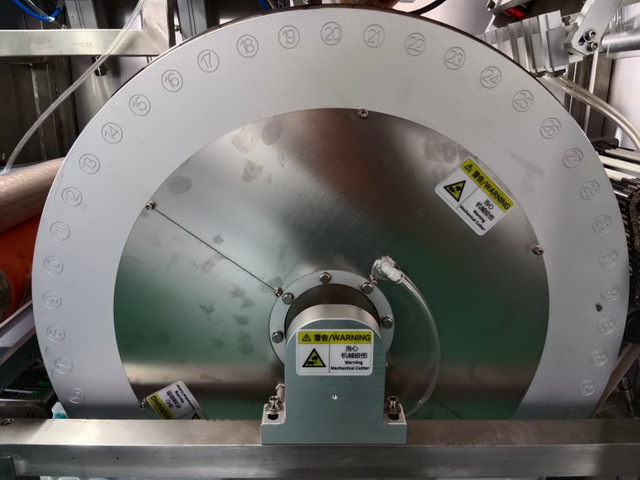
Their filling machines feature a unique cutting design and are built for ease of operation, reducing downtime on the production floor. For startups entering the pod market or established brands scaling up capacity, having a single supplier that covers both film and machinery simplifies procurement and quality control.
Whether you're a brand formulating your first pod product or a procurement team reviewing supplier options, these are the questions worth asking:
Dissolving performance: At what temperature does the film fully dissolve, and has it been tested in real wash conditions?
Certifications: Does the supplier hold ISO9001 certification, and has the film been tested for ecotoxicity and heavy metals?
Biodegradability data: What is the documented degradation rate under composting and sewage conditions?
Customization options: Can dissolving speed and film thickness be adjusted for your specific formulation?
Market history: Which regions does the supplier currently serve, and what volumes are they producing?
Proudly's track record—over 10,000 tons of film sold annually across global markets, with a team of 300+ employees and 19+ years in the industry—answers several of those questions upfront.
Laundry pods succeeded because they made washing simpler. But the film that makes that simplicity possible requires precision manufacturing, rigorous testing, and a clear understanding of how materials behave across different wash conditions and environmental systems.
For brands, the sourcing decision is a product decision. For consumers, it's worth knowing that the best pods on the market—whether purchased in Seoul, Los Angeles, or London—are backed by film technology that has been engineered to perform and then disappear without a trace.
To learn more about Proudly's water-soluble film and laundry pod products, visit www.proudly.com.cn or contact their team directly for specifications and pricing.
Yes. PVA film dissolves in water and biodegrades under sewage conditions at a rate of ≥75% within 72 days. It does not accumulate in pipes or septic tanks the way conventional plastic would.
Premium PVA films, such as Proudly's GX model, are engineered with adjustable dissolving temperatures. This means they can be formulated to dissolve reliably in cold water—an important specification for markets where cold-water washing is standard.
Look for ISO9001 certification, ecotoxicity test results, heavy metal test clearance, and documented biodegradability rates under both composting and sewage conditions.
Unlike conventional plastic, PVA film is water-soluble and biodegradable. It dissolves on contact with wash water, releases the detergent inside, and breaks down in wastewater systems without leaving microplastic residue.
Proudly supplies water-soluble PVA film to manufacturers across Europe, North America, and the Chinese mainland. Their products are used in laundry pods, medical water-soluble bags, industrial packaging, and other applications requiring biodegradable containment.